


Instrument of Destruction

Updated: Apr 13
Megadeth and Me
When it was offered, I leapt at the chance to be on the security team for a Megadeth concert in Edmonton last Saturday. While I’m not a huge fan of Megadeth—having only three songs by them sitting on a Spotify playlist—the band is the second most commercially successful metal band in the world, so they’re a big deal. I like working that kind of show.
What I didn’t expect was to be caught in a portentous moment with a foolish fan and Dave Mustaine himself.
Dave Mustaine, the founder, leader, and sole consistent member of Megadeth is one of the most successful talents in his genre. However, being nearly the most successful has never been quite enough for Mr. Mustaine. Because of this, there are names and words that cannot be said aloud in his presence.
During a lull in this night’s performance, Dave was speaking to the crowd when a fan shouted out to Dave. He spoke the forbidden words, and he named He-Who-Must-Not-Be-Named… and Dave Mustaine heard him loud and clear.
Dave bent all of his focus, and the focus of ten thousand fans, on that one young man, and by pure chance, I was to be his instrument of destruction.
Crowd Surfing
Before I get to the fate of that fan, I have to go over a couple things for anyone who’s never experienced an arena event. I got my first taste at a Pearl Jam concert in August of ’93. This is back when their breakout album Ten was also their collected works. Vs. wasn’t to come out for a couple months. Hard to believe, but when they performed classics like Daughter and Dissident, we were putting up with “new stuff” bands insist on playing when all fans want is the established hits. There were no assigned seats, just a churning mass of humanity crowded into a small venue called Max Bell Arena. It cost me, and 4,700 others, just $23.25 to attend.
It’s the only time I’ve ever crowd surfed, but I still remember the thrill of being held aloft by many hands of perfect strangers. You’re swept along with no control over where you’ll go. Indeed, no one in the crowd is controlling your direction either. The collective is moving you along with no one at the wheel.

That said, everyone seems to have it in mind that a surfer should be heading toward the stage. Even if you take a wandering path, your general direction will be band-ward. But there’s a barricade between the crowd and the stage, an impenetrable steel gate 4 feet high, enforcing a 10 to 12 foot gap between the fans and the stage. When the surfer reaches the end of the crowd, they’ll drop from 6 feet in the air onto solid concrete and steel braces. Worse yet, they fall from a horizontal orientation with no firm anchor point to leverage and thereby control their fall. Even a cat might not fair well.
Barricade
This is where I come in. Crowd surfing is dangerous. It’s been banned in many venues, and it’d be banned in all of them if it weren’t for security teams assigned to catch surfers when they come to the end of the ride. I work security at a couple venues where crowd surfing is fair game. It’s expected and planned for.

This is a concert barricade. It is a brilliantly simple and effective design. The fans are on the side where you see the flat plate of steel with the three yellow stripes. They press up against the barricade to be as close to the action as possible, and there will be three rows of fans on that plate. Their own mass keeps that section in place as though it’s welded to the floor.
You’ll want two strong hombres to lift each of these sections into place, and they are linked together along the front of the stage with steel pins. There are no gaps, and it can even wrap corners with specialized sections. It’s formidable.
Me and the security team stand on the side where you see the bracing and the bench, one of us for every two sections, depending on how much surfing and fighting is anticipated. That bench is about the height of a normal chair.
Given that a surfer will get dropped over that barricade sunny side up from about 6 or 7 feet, you can see how grave the danger is. They stand a good chance of cracking the back of their skulls or base of their spines on one of those braces before crashing to the concrete below for the coup de grace. We’re talking life-threatening or life-changing injury here.
Worst of all, the surfers themselves are utterly heedless to this hazard. They are so drunk, so high, or so caught up in the elation of being in this moment with their favorite band that they laugh and sing as they are swept along by an anonymous mob that will cheerfully cast them down without mercy or remorse.
On the barricade team, we put ourselves between them and that concrete floor.
Fans often have the impression that security is their adversary at a concert, but nothing could be further from the truth, especially when it comes to barricade duty. We’re there to care for the fans’ well-being so that they don’t have to.
When a surfer goes up, the security staff has a strict protocol:
Everyone with eyes on the surfer points them out
We keep pointing till they are caught at the barricade or fall back into the crowd
Whoever’s closest steps up on the bench
When they step up, the man beside him puts hands on his back to brace him
The guy catching gets control of the surfer under the armpits and at the bend of the knee
Once they have the surfer in their arms, they step straight backwards, relying on their teammate to brace them and absorb the extra weight
They set the fan on their feet and direct them out of the barricade
The pointing is key because verbal communication is not an option in the din of a concert and the space immediately in front of you is the hardest to see. With fans leaping up and down, arms in the air, it’s easier to see into the crowd at angles than it is straight on.
Gaining control of the fan can be a real challenge because they come in at random angles, and their motion is unpredictable. With the chaos of many hands directing the movement, neither the surfer, nor the crowd, and least of all the security guy, can anticipate the direction a surfer will go.
The feetfirst approach is daunting. They always seem to get one last push as they head your way, and you’ll catch a foot in the teeth if you aren’t ready and sometimes even if you are.
Headfirst is nerve-racking because that’s the one part we have to protect at all costs. If a head gets past you, you’ve just let in the game-losing goal, and that fan’s got a date with the paramedics.
It’d be nice if they all came in sideways, slow and steady so that I could just put my arms out, cradle them and step back, that’d be a walk in the park, but it doesn’t often go that way.
Stepping straight back, knowing your teammate is there to support you, is a trust exercise on steroids. It’s instinctual to turn back so you can watch where you’re stepping, but it is a bad idea. Even if you’ve got a mere 160-pounder cradled in your arms, twisting your back with that extra weight is a sure route to the chiropractor and massage therapist. You gotta step straight backwards off the bench with one leg and let the fan’s butt down onto your raised knee that’s still on the bench.
Because every crowd surfer is a potential life-threatening injury in progress, our supervisors go over the protocol in depth before a show like Megadeth and give stern admonitions about the seriousness of the work. Here’s a few excerpts.
“Barricade is not right for everybody. If I see you struggling, if I see you’re not paying attention, if I catch you lookin’ at the show going on behind you, I’m taking you out of there, right away. No questions asked; you’re gone. Don’t take it personal. It’s for the safety of the fans and yours too. I don’t want anybody getting hurt. Clear?”
“Listen, you’re gonna get kicked in the face, you’re gonna take an elbow to the head. You’ll get punched, kneed, I guarantee it. But you can never take that out on the fan. They’re having fun; that’s their job. Keeping them safe… that’s your job. So when you get clocked, just channel that. Fight for that control, that solid hold, and get them safe on their feet. Then it’s a smile, a pat on the back, and ‘See you again soon, man!’ That’s what we do.”
Then some of the vets went through a number of scenarios of how to deflect feet and legs to get somebody turned so you can get a safe hold on them. It was all good info., but it reminded me of talking about fighting.
In Taekwon-do class, we will often talk about contingencies to frontal attacks. How to block kicks and punches, appropriate counterattacks and defences, and so on. It’s all very good in theory; it just has limited real world value. At the end of the day, you need to hop in the ring with someone better than you, go at it hammer and tongs, and fail your way to success.
In the ring, someone throwing fists at you might be trying to land a scoring blow, but they also might be giving you some eye-candy so that you raise your guard and leave your torso open. You don’t learn the difference between eye-candy and a genuine threat by getting verbal instruction. You learn it by falling for the ruse and getting cracked in the ribs with a turning kick.
Barricade work is like that. Talk all you want, but you’ll soon discover there’s no manual for catching a +200lbs., rowdy, drunk dude coming at your face wearing his size 13 combat boots. That’s a read and react situation. Somebody working the barricade needs to be strong, calm, and above all, game. Game for whatever comes.
Front and Center
I’m still very new to the company, and this was my first big event. I’d worked the concert hall at the Grey Eagle Casino, but that place probably holds two or three thousand at most. This venue, Rogers Place, hosts NHL hockey games, so it’s a true arena that can house tens of thousands. I believe I was mistaken for an old campaigner by the Edmonton crew and their leaders who made the schedule. It’s easy to see how it happened; I’m no spring chicken, and I also rolled in with my friend, Poops, who’s a big cheese at the company. I got assigned to a spot right in the middle of the action, center stage. On my left, I had the two guys who’d led the barricade training, and on my right was one of their team leaders.
Poops walked past and said, “Well, look at you.” He chuckled. “Don’t screw it up.”
As the arena filled with concert goers, I watched my fellow guards preparing for the event. They were having light-hearted chats with each other and the fans, but all the while, they were putting in ear protection, pulling on protective gloves, stretching and doing calisthenics like Spartans on the cusp of Thermopylae.
Seeing these grim preparations was a bit sobering, so I went through some stretches of my own that I do before a TKD tournament.
The Fog of War
A metal concert is a sensory explosion. The music itself is intentionally aggressive and jarring. Thousands of fans shout, and the front man bellows encouragement to get louder into the mic. It’s a full-throated roar with high-pitched spikes from screams and piercing chords from amplified guitars.
The sound can be felt. Standing immediately in front of the speakers, the percussion and bass beat against my back like a gusting wind.
The lights drop to blackout, flash brightly in different colors, and switch to strobe. The audience is a seething mass, mostly raised arms, nodding heads, swirling hair. Behind them is a void, where the rays of light play on the haze from fog machines, joints, and vapes. The surrounding arena is invisible but for the points of light in the distance, shining out from phones filming the show.
I feel it as an assault, a sustained attack against the senses, and I quickly begin to disregard everything that is not a part of the job. I dismiss the sound. I’m not here for the music, and my colleagues will use hand signals to communicate with me.
I don’t watch the light show or glance back at the stage. I note only three things: the guards in my peripheral vision, faces in front of me (watching for distress or fainting), and the forest of arms in my section in front of me. I’m scanning those arms for shoes and boots; that’s the tell. Arms and heads are all distractions, but if we see a foot, that’s a surfer coming in.
He-Who-Shall-Not-Be-Named
I was in a hot spot. Nodes of surfing occur at every concert, and this one was popping off right in front of me. I stopped keeping track of them at around 20. They ranged from a teensy lady, probably under 100 lbs.—a cake walk—to a dude about 230 lbs. who went limp as a sack of beans in my arms instead of grabbing on to help—not so easy. Still, I loved every second of it, and everything was going smoothly until one fan said the unthinkable.
Again, saying anything at a metal concert is usually meaningless; nothing but the music and collective screams can be heard. But every five or six songs, the band will usually stop for a minute, and the lead singer/front man will chat with the crowd. He’ll tell them they’re so much better than the crowd last night at the nearby rival city, tell them about a new album dropping soon, and say that all the fame and fortune is nothing “It’s all about you: the fans!” These are the talking points, and they are followed as faithfully as liturgy.
Dave Mustaine was in the second of these intermissions, the last one before the final set, when it happened. The crowd was quiet as he spoke. I snuck a peek over my left shoulder, and saw him just 10 feet behind me, sitting on a stool center stage, a spotlight on him, his white shirt and red hair brilliantly illuminated in an iconic shot of the metal legend against a black void.
In a small silence between the rocker’s sentences, a fan in front of me shouted out, “Dave! You’re better than Metallica!”
A word about Dave Mustaine and Metallica…

For those who know the full story, I apologize for the brevity of this summary. Metallica is the most commercially successful metal band of all time. It is not even close. They are the most successful by orders of magnitude.
Dave Mustaine was the lead guitarist for Metallica from ’81 to ’83, but he was ousted by the other members. The stated reasons are a mixture of personality conflicts and excessive drug and alcohol abuse.
Now, Dave has had an amazingly successful career of his own. He’s universally acknowledged as one of the greatest metal guitarists of all time, and he founded Megadeth, the runner-up in what’s called the Big Four of thrash metal. And, really, you can think of Megadeth and Dave Mustaine as the same thing; he’s the only consistent member since he’s renowned for not playing well with others. Indeed, if Dave was capable of maintaining a relationship with other artists for more than a few months, I’d have seen Megadeth open for Aerosmith in the early 90s. But the limited time afforded to opening acts was a slight upon Mr. Mustaine’s ego, words were said, Aerosmith and Dave parted ways, and I had to watch some chumps named Jackyl perform their signature "chainsaw solo" as a warmup to the boys from Boston.
Despite all this drama, Dave still holds an unimpeachable status as a giant of the metal world, and yet he’s forever defined himself as the guy who lost gold, not the guy who won silver. Not being number one is all he sees. He was interviewed in a documentary about Metallica called Some Kind of Monster circa 2003, around 20 years since he was fired from Metallica, and if you didn’t see the middle aged man speaking, if you just read the transcript, you’d swear this was a little boy wondering why he wasn’t given a second chance, why he can’t play with his friends anymore. It’s actually really heartbreaking.
Dave is known the world over for his temperamental nature and moodiness, so there are certain names you do not speak in his presence. Here’s a few important examples: James Hetfield or Lars Ulrich (the guys who punted him from Metallica; Kirk Hammett (the guitarist who replaced him); and above all, for the love of all things good and holy, you do not say “Metallica” in the presence of Dave Mustaine. You don’t say it in passing, certainly not in praise, you don’t even say it to give Dave a flattering comparison to them. You don’t say it at all.
The Righteous Right Hand
Talk about bad timing. Just think about when this kid said what he said. Word has it that this is Megadeth’s victory lap, the last tour, the big finale. Dave is taking a breath before the crescendo to his show. This is his moment, his reflection on a great career, his swan song, and this kid picks this moment to rub a handful of salt in the wound that has never healed.
Here’s the conversation that ensued; apologies for the language, but we are quoting a rockstar here.
“Dave! You’re better than Metallica!”
“Yeah, I already f**kin’ knew that,” Dave said. “Anything else you need to say?”
“How does it feel to be better than James?” The kid went on, just to break another taboo, I suppose.
“Is this really how you want to use your f**kin’ 15 seconds of fame? Ya little sh*t?”
“F**k you, Dave,” he said, raising his middle finger. This was a mistake. Only those around him could hear him, but Dave amplified his message.
“Oh, f**k me, huh? You giving me the finger now?”
A low and threatening chorus of boos rose from the crowd. This pissant’s going to get himself torn apart, I thought, seeing a few offended fans starting to size him up.
“Hey, you,” Dave said, pointing at the kid’s friend. “Yeah, you. Take your hand and put it over his mouth.”
The friend smiled and made the motion of putting a hand on his buddy’s mouth but didn’t actually do it.
“No, seriously,” Dave went on. “Put your f**kin’ hand on his mouth. Do him a favor.”
The friend did, though he didn’t clamp down, still thinking this was lighthearted banter, but Dave was sounding serious to me.
The kid brandished his middle finger again.
“Yeah, I see you,” Dave said. “Is that all you got?”
I realized that if Dave tired of this, he might say something like, Get him out of here! and, as the nearest guard, I would be compelled to action.
The kid looked about 25 to me, judging by the not-quite-filled-in mustache. He wasn’t very big, maybe 170-175 lbs. He probably thought he was safe, being one row deep on the other side of the barricade, but he was not. I judged the distance and thought it out.
Sudden and swift, get him over the wall before he even realizes the danger. One step onto the bench, hands clamped on his collar or scruff, yanking him forward, grip under the armpits, and yoink, he’s on the wrong side of the barricade and you’re showing him a door to the parking lot.
I took a step forward and put a hand on the top rail. He saw me, and Dave did too.
“Oh, look. See that?” Dave sneered. “You’re makin’ all the wrong decisions now, aren’t you?”
The kid looked from Dave to me, and I was wishing I could speak into his mind or communicate with a look: Listen, son, there is literally no separation between Dave Mustaine’s will and whatever potential for violence I may have. In this moment, his word and my action are the very same thing. I am Dave’s righteous right hand, and you are well within reach. An admittedly long and complex message for a mere look, but maybe the gist of it got across.
“I’m sorry,” he yelled out, but for some unknowable reason, he kept waving that middle finger at Dave!
Just say ‘No’ to drugs, kids.
Dave accepted this mixed-message apology, in his unique fashion, saying, “Oh, you’re sorry now. Yeah, you’re a sorry sack of sh*t. That’s what you are. This next song fits you just perfect. It’s called I don’t care!” and then he launched into the final set.
I don’t know if Dave changed the set order on the fly or not, but the song certainly paints a nasty portrait of a wretched individual in the chorus, so it was a decent rejoinder to be sure.
Moments
Megadeth, and the openers Exodus and Anthrax, put on a fantastic show. I didn’t get to see even one minute of it directly. If a surfer pops up close to the barricade, you don’t even have time to point. You have to jump up and catch them right away or throw yourself under them if you’re not quick enough, so there is no watching the show when you’re on barricade detail. But you can feel the energy. It’s a feast of vicarious joy as you see the fans singing and chanting as one. I can’t believe I get paid to do it, and the thrill of the work is well worth the bruises and sore back the next day.
I don’t know if it’s a symptom of age, but I’m beginning to see my life in a series of crystalized moments—moments that I get to keep whatever else might occur. I like to write about them here on the site. Getting stalked by a mountain lion, calling in an ornery bull moose to less than 10 yards, sparring with a Taekwon-do Master, all of these are moments that I get to carry around till the end of my days.
This is another one that I’ll keep handy and look over from time to time. That moment when this fan stood on the brink of getting dragged out of the arena—to fans cheering and Dave jeering, no doubt—and me as the instrument of Dave’s decree. It was narrowly averted by the whim of a man who’s shown a propensity for overreaction. As I revisit it, I don’t wish that it ended in dragging the poor wretch out the door, nor am I relieved or pleased it didn’t go in that direction, it was simply a great moment to be a part of, a unique and memorable experience that comes with working the barricade.
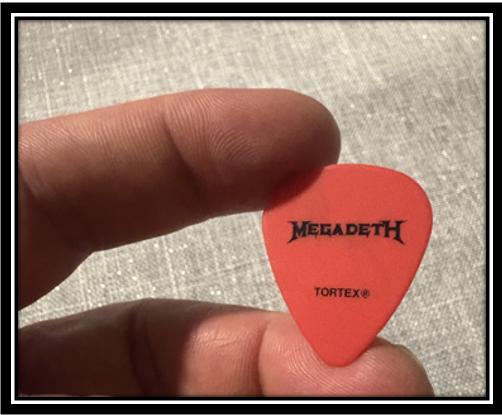
I even came away with a memento of my evening with Megadeth. One of the souvenir guitar picks that get thrown to the fans after the show didn’t quite make it past the barricade. Poops found it as we left the stage area, and guess who he gave it to! Now that’s a good pal.


LOL!! What a wild experience. Thanks for writing it up in such a compelling way.