


Law Abiding Citizens

Updated: Mar 6
The world of retail is intriguing. As a customer, I’ve found an empty shelf before, and I’ve asked if they “Have any in the back.” Now I’m learning where “the back” is and how to get things from there. It involves a lot of navigation on a device that looks like an iPhone, but it ain’t no iPhone. iPhones are designed to be user friendly. These things are not. At Bear Peak Supply, these devices are called “Zebras” because that’s the brand of the unit. Personally, I’d rather deal with a real-live pissed off zebra than one of these unruly, finicky tablets.
I’m sure that with a few reps, it’ll all become second nature. The really strange thing about working retail is the interactions with customers. I’m helping people supply themselves for hunting—a pursuit I can say I know a fair bit about—and I’d naively hoped that other people who go hunting might know something about it as well. Nope.
To be clear, I’m not saying that I’d hoped everyone would be an expert or that novices aren’t welcome in the sport. But I really did hope that folks would at least mildly acquaint themselves with things like laws and firearms before they went out blasting. Vain hopes both.
Fill ‘er up with Unleaded
The other day, I was restocking ammo—a constant necessity in our store—when a cashier escorted a customer from the checkout area back to the ammo section. He wanted to do an exchange. You aren’t allowed to return ammunition, but the cashier was this man’s witness that it hadn’t left the store (the concern is that returned ammo could be tampered with).
So I asked the guy what the mistake was. He’d bought shotgun shells that had steel shot, and he wanted to get ones that had lead shot. See, shotguns are the ones that most often shoot a cloud of small metal balls, and hunters use them for birds. They can shoot real teensy ones, or real big ones, and the balls can be made of different materials like lead or steel. Sometimes the packaging is similar, and it’s possible a dude could accidentally pickup one or the other by accident.
I asked, “So you bought the steel shot, and you were looking for lead?”
“Yeah, I want the lead ones.”
“Cool,” I said. “So you’re going for upland game birds, not migratory. Right?”
“What?” he said, looking at me like I was speaking another language.
That was cause for concern. Look, if you do not know the difference between an upland game bird and a migratory bird, that’s okay. It’s okay because I assume you’re not about to go kill a truck load of them. If you are about to do that, I’d hope you’d learn to identify what it is you’re shooting.
“Uh…” I said. “You know… upland game birds. Like… grouse, partridges… that’s what you’re hunting, right?”
“I don’t think so.”
“All right,” I decide to ignore the alarming nature of the response I don’t think so to an inquiry about what he's aiming to kill and forge ahead. “So are you hunting ducks and geese then?”
“Yeah, ducks and geese.”
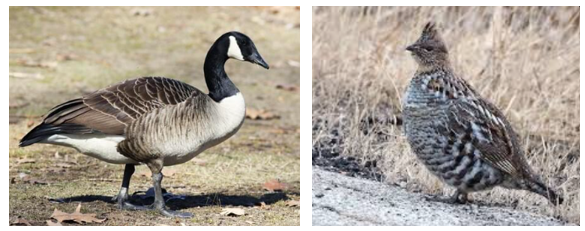
If you look closely, you’ll see theses birds are different, and you really ought to know which one you’re hunting.
“Okay, so those are migratory birds, and you have to hunt those with steel shot.”
“You do?”
“Yeah… it’s kind of a significant regulation.”
“Why?”
“I mean… I don’t hunt migratory birds, but I think it’s a couple things. Like, lead leeches into the water table because they are always in waterways, and if you wing one… who knows where it ends up. It could drop into our reservoir, or a reservoir in south Texas for that matter.”
“And it’s illegal.”
“Yeah, it’s illegal to even have lead shot in your possession when you’re hunting ducks and geese. You get stopped by a game warden and that’s the first thing they check.”
The guy thanked me and went off with the steel shot that he’d originally purchased, but I couldn’t help but wonder what else he didn’t know.
Please do not shoot a deer with that tag, my friend
On the same day, I see two guys paging through the hunting regulations, a magazine-sized free publication issued each year that explains interesting things like what a goose is and what you can and can’t shoot one with.
The guys were standing by some deer calls that I was restocking, and I asked if they needed any help. One of them said, “Do you know anything about the Supplemental Whitetail tag?"
“Yeah, I do. I buy that tag every year.” In fact, I’ve bought it for more than 10 years and usually attach it to a doe in early September.
“Oh, great. Can we use it in five-one-four?” he asked.
That’s when I saw that they had two deer tags in hand that they’d just bought up at the till, and they were only now wondering if they’d purchased the right tags for the hunt they had in mind. As a rule, in case you’re thinking of taking up hunting, you should first determine if what you have in mind is within the law, and THEN go buy the tags and gear to act on that plan. Alberta is divided into more than 100 different wildlife management units (WMUs), each with different rules about each game animal, so you need to consult the regulations, and carefully at that.

Pictured Above: 96 pages that will keep you legal if you actually read and apply them.
They were clearly rookies. In Alberta, I’ve never met the hunter who’d say “five-one-four” instead of “five-fourteen.” So I decided to help them out and keep them legal.
“Well, here’s the thing,” I said, “I hunt in three-twelve and three-ten, so I know all the regulations for the supplemental tag in those sections, but I don’t know them by heart for five-fourteen. But I can show you how to check.”
“Oh, that’d be great.”
So I opened up the regs and showed them how to check the rules about their two deer tags in each section. Turns out, one of them is completely invalid for five-fourteen. If they’d tagged a deer with it and been caught, they’d be busted for poaching. Realizing they had a tag they couldn’t use, they were crestfallen. Then they asked me where they could use it.
Having just showed them how to look up whether or not they could use it in five-fourteen, it was my turn to be crestfallen. I showed them the map of 100 different zones, and I explained again that you need to look up the rules for each one, not just for the supplemental tag, mind you, but for EVERY SINGLE tag.
I walked them through the process, and to their credit, they were attentive and thankful. But I’m guessing there’s still only about a 50/50 chance that these guys manage to stay on the right side of the law.
Yes, sir. That is a very deadly shell you’re holding
But this is the one that terrifies me. Later on, a guy comes and asks me where the 308 ammunition is. Well, I suppose he didn’t precisely ask. He just walked up to me, looking mystified, and went, “Three… Zero… Eight… … …” He checks his phone. “Winchester?”
And I said, “Right here, sir,” showing him the exact place he’d been looking on the shelf, but placing my finger directly on to the lettering 308 Winchester.
For any readers who aren’t shooters, the 308 Win is a decent all-round load for big game. My dad used one for many years because rifles are expensive, and if you only own one, it’s a great choice. It’s a little smaller than you’d want for a moose, but it’ll do the job with a well-placed shot, and I watched dad kill moose and elk with it since I was a kid. On the other end of the big game spectrum, it’s overkill for a deer. You want to put your shot in one side of the ribcage and out the other because a shoulder shot could destroy about 25% of your roasts. But in general, it will cover all your big game needs. Indeed, a real nice whitetail buck is pictured on the box lest you not know what to do with these shells.
I showed this guy our selection of 308 ammo. There are many brands that have different features, but they will all fire out of his rifle. After hemming and hawing over which brand of ammo to buy, the guy finally settled on the cheapest one. He pried open the box and took out a shell. I don’t think we like that as a matter of policy, but we don’t make much of an attempt to curtail it either.
He then wanders down the ammo aisle as I continue restocking, and I see that he’s looking at some other boxes of shells. I’m not sure why he was browsing around other loads because I’m thinking he’s only got one gun that he bought or borrowed. He was standing within arm’s reach of the shells he was asking for, and the term “308 Winchester” sounded awkward and new coming out of his mouth. To be fair, we clearly had a different first language, but still… there’s just something about the way people handle guns and ammo (or even look or ask about ammo) that tells you they’ve had no experience with it before.
This guy was examining many shells for rifles like the 30-06, or the 300 Win Mag, and even 338s. These shells cannot be fit into the chamber of his 308. The aisle is arranged in ascending order of calibers, so by the time he got to the end, he was looking at some truly terrifying loads.
He got real interested in the 458 Winchester Magnum shells. I’m not even sure why we stock these things, since there’s nothing on this continent big enough to shoot them at. To a hunter’s eye, these shells look like anti-tank munitions. Unless you’re hoping to penetrate the skull of an elephant or cape buffalo, the only use for them is dislocating your shoulder at the rifle range. That’s not an exaggeration, by the way. Even experienced shooters will shy away from touching off one of those canons. They kick so hard you’d think you were the shootee, not the shooter.
I see this guy pull out one of those rounds and compare it to the 308 round. He’s kind of hefting them, sizing them up, and I realize that he’s thinking the 308 is a bit on the small side. I’m hoping and praying that this is not what he’s thinking, but our next interaction removes all doubt.

He comes up to me, holds up the box, and asks, “This… Three… Zero… Eight… Winchester?”
Ignoring that the box still says 308 Winchester in bold, black lettering, I said, “Yes, that’s 308 Winchester.”
“This good for deer?” he says, his tone doubtful in the extreme.
I said, “Yes, lot’s of hunters use that for deer.”
“Big enough?” he asks.
“Yes,” I said. “I killed my first deer with one of these. It will even kill moose or elk. It’s big enough to kill anything you’re hunting.”
“Look small,” he said.
I looked down at the box again—308 Winchester, 180 grains—and sighed. They didn’t look deadly enough to this guy.
I know I’ve already mentioned that these shells will take down a moose, but I feel the need to clarify just how devastating these rounds are. I mean, you’ve seen war movies, right? These shells are similar to what you see getting shot in all those Vietnam movies, but they are far more deadly. There’s more powder exploding behind them, and the bullet’s around 30% bigger. Plus, the bullet isn’t fully sheathed in a metal jacket like the army rounds. It’s got a naked lead tip so that it doubles in diameter as it pulverizes bone and meat. This disperses the bullet’s energy across a wide area so that a projectile the size of a kidney bean creates a path of catastrophic trauma the diameter of a football.
A war round is designed to fly through a body and let a dude go home wounded if possible, while a game round is designed to expand and instantly kill creatures that are far more hardy than man. Each round holds a fearsome potential for devastating injury and death.
This guy was toying with 20 of them, saying they “look small.” The thought of him putting these shells into a rifle and closing the bolt made me feel ill.
“No,” I said. “It’s not small. It’s big. Like… trust me. Very big.”
“It kill the deer?”
Sweet and merciful Lord, protect us this day, and all of our days. “Yes, sir. This will kill a deer,” I said. Then I added, “Very dangerous.”
Looking at the rounds again, he came to a decision. “Okay. I trust.”
Right. That makes one of us. Out loud, I said, “All right, good luck.”
And off he went. Yes, folks, I’m afraid this guy is out there somewhere, with his “look small” gun that could kill you with an errant shot in the leg, never mind the vitals.
Watching him leave, I wondered if I should give his description to authorities in advance or tackle him in the parking lot and wrest those shells from his hands. But I did neither.
He’s a smaller guy: 5’8”, and probably only a buck-forty. If we’re lucky, he’ll go out to the range, touch off one of those “look small” rounds, and get knocked clean on his ass by the recoil. Maybe then it’ll “look big” and he’ll give it its due respect.
Working the hunting section in Bear Peak is reminding me of my time as a university prof: no matter how fully and simply I explain assignments or tasks, there are those who will still find a way to get it all wrong. And just as there are some students who really did not belong in the university's hallowed halls, there are a few guys out there who never should have picked up a hunting tag, rifle, or ammunition. If there's a moral to this story, I suppose it's this: Read your dang regulations, and keep a weather eye out for small men toting big rifles.


Comments